
Building a Data-Driven Operating Model for Semiconductor Fab Projects
A Practitioner's Framework for Lifecycle Data Governance on Billion-Dollar Fab Programs
Written by Dana Wells

Semiconductor fabs are among the most data-intensive capital projects ever built.
A leading-edge fab — with millions of square feet of cleanroom, thousands of process tool tags, ultra-complex MEP and utility systems, and multi-billion-dollar budgets — demands a data operating model that matches its complexity. Yet most EPC organizations approach fab data management the same way they approach a conventional industrial plant: reactively, informally, and without a governance framework. The result is cost and schedule overruns that are preventable, not inevitable.
This article lays out a practical framework for building a data-driven operating model for semiconductor fab lifecycle management — from how to structure data hierarchies to how to integrate systems, manage three versions of financial truth, and convert project actuals into lasting competitive intelligence.
It is written for practitioners: project directors, project controls leads, PMO heads, and owners who are accountable for delivery outcomes, not for technology vendors selling platforms.
The Four-Level Data Hierarchy — How Granular Do You Need to Go?
Before a single estimate is issued or a schedule baseline is set, leadership must agree on the depth of the data structure the project will operate within. Fab projects are not amenable to the two-level reporting models that serve simpler capital programs. The scale, system complexity, and handover requirements of a modern fab demand four distinct levels of data granularity — each owned, maintained, and reported against by a defined organizational role.
● Level 1 — Project / Program: Portfolio KPIs, cross-project benchmarking, and executive dashboard metrics. This is the PMO's domain. It provides leadership visibility across programs but offers no meaningful diagnostic capability on its own.
● Level 2 — Phase / Discipline: Cost and schedule broken out by engineering, procurement, construction, and commissioning discipline. Owned by Project Controls. Sufficient for trend monitoring but not for root-cause analysis or system turnover planning.
● Level 3 — System / Area / Work Package: Process system, cleanroom zone, utility corridor, equipment train. Owned by the Lead Engineer or Lead Planner. This is where execution accountability lives — and where forecast accuracy becomes meaningful.
● Level 4 — Equipment / Tag / Activity: Tag-level cost, vendor data, field installation status, and inspection and test plan (ITP) records. Owned by the Discipline Engineer and Field Superintendent. This is the atomic unit of fab project data — the level at which punchlist items, turnover packages, and commissioning sequences are ultimately resolved.
"Fab projects require Level 3–4 granularity for cost certainty and system turnover control. Level 1–2 reporting alone is executive theater."
The Work Breakdown Structure (WBS) and Cost Breakdown Structure (CBS) must be aligned across all systems from day one. When the WBS used in the project schedule does not match the CBS used in the cost management system, reconciliation becomes a manual, time-consuming exercise that introduces error and delays decision-making. In practice, misaligned WBS/CBS structures are one of the most common and most costly data failures on large fab programs — and they are entirely avoidable with a governance decision made before FEED begins.
Critical Data Points Across the Lifecycle
Every phase of a fab project generates data. The discipline is in knowing which data is non-negotiable — the anchors that must be captured, validated, and preserved as the project progresses. Organizations
that fail to define these anchors in advance spend the back half of execution trying to reconstruct what they should have captured in the front half.
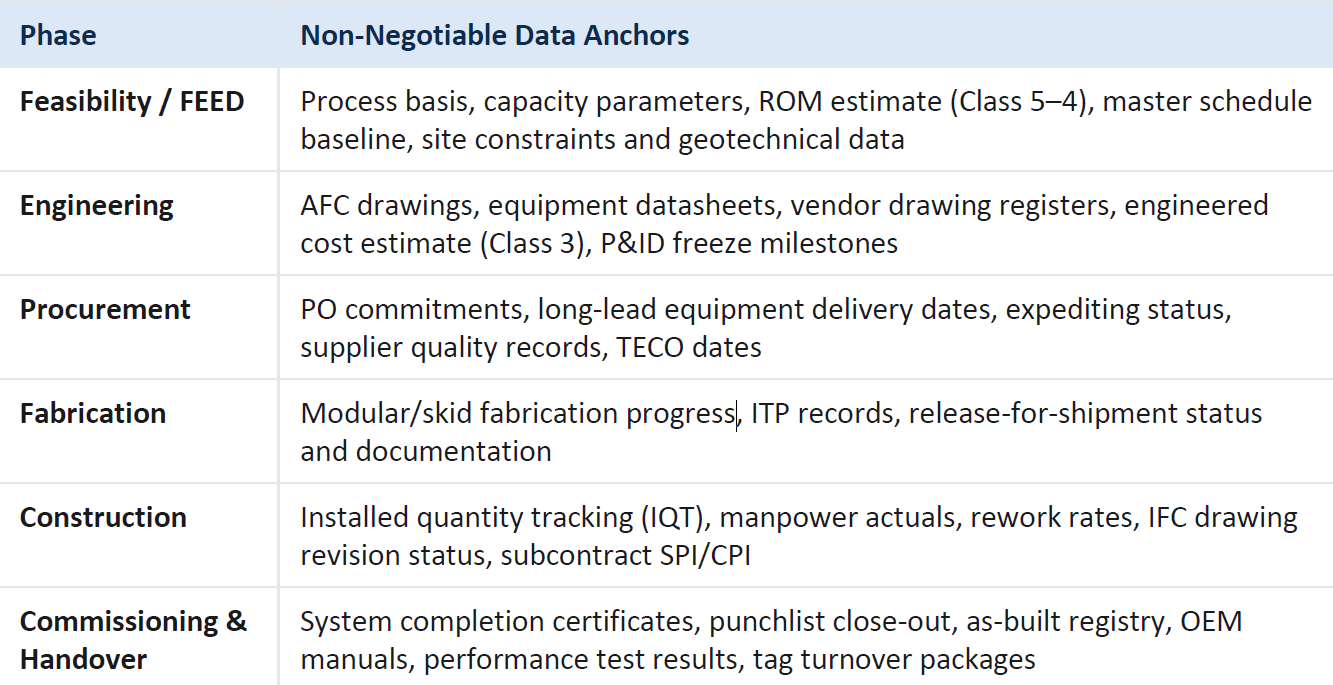
The critical governance rule: the lifecycle data model must be defined before FEED is complete. Retrofitting a data structure mid-execution is costly, disruptive, and rarely successful. Teams that attempt to impose a new data hierarchy at 40% or 60% engineering completion invariably find that existing cost codes, schedule activities, and document structures resist realignment — producing a hybrid model that satisfies neither the original structure nor the new one.
“Attempting to impose a new data hierarchy after FEED completion is one of the most expensive project controls decisions an EPC can make. It produces a hybrid model that serves no one.”
Plan, Forecast, and Actual — Managing Three Versions of Truth
This is the most consequential section of this framework — and the area where the largest number of EPC organizations make the most damaging mistakes. Many teams conflate the baseline plan, the forecast, and the actual into a single reporting stream. The result is reports that are neither a reliable
reference point nor a useful decision tool. Leadership ends up managing against numbers that mean nothing in isolation.
These are three fundamentally different data objects. They must be defined, governed, and maintained separately:
● Baseline Plan (Locked): Set at project sanction and Final Investment Decision (FID). This represents the contractual commitment — the number against which all variance is measured. It's changed only through a formal change control process. The baseline is never overwritten; it is frozen as a permanent reference point. Any team that overwrites the baseline to "reflect current reality" has destroyed its ability to perform variance analysis — and has lost the single most important tool for accountability.
● Forecast (EAC/ETC): The Estimate at Completion and Estimate to Complete are the owner-facing forward projections. Updated at a minimum monthly; weekly during critical execution phases. The forecast reflects current risk exposure, mitigation actions in play, and earned value performance trends. It is the living decision tool — the number that drives resource allocation, risk response, and executive decision-making.
● Actual: System-recorded only. Drawn from time-entry systems, ERP invoice feeds, and installed quantity field reports. If a system feed exists, actuals are never manually entered. Manual entry of actuals introduces reconciliation risk and undermines the integrity of earned value calculations.
"The plan is a contract. The forecast is a decision tool. The actual is evidence. Treat them as separate data objects — never blend."
Maintaining this discipline requires governance infrastructure, not just intention. Specifically: a formal change control procedure with defined approval thresholds and turnaround timelines; an EAC cycle governance process that specifies who prepares, reviews, and approves the monthly forecast; and named cost engineer accountabilities by discipline and area — so that the forecast is not a committee product but an owned deliverable.
Organizations that conflate the plan and forecast typically discover the damage when a risk event occurs. With no locked baseline, there is no variance to measure — and no way to determine whether the risk event caused the overrun, or whether the overrun predated the risk event entirely.
Update Cadence and Milestone Triggers
Data cadence must be governance-driven, not convenience-driven. The most common failure mode is defaulting to a monthly update cycle across all phases — including peak construction — because monthly reporting is what the PMO has always done. On a fast-moving fab construction program, monthly cadence creates data latency that compounds into unrecoverable positions.
Standard Update Cadence
● Weekly: Construction period cost and schedule updates during peak execution. Field quantity actuals, manpower, and subcontract performance indicators.
● Monthly: Full project forecast (EAC/ETC) across all disciplines and phases. Risk register review. Procurement commitment summary.
● Real-Time: Procurement commitment tracking — PO issued, amended, or closed. Material delivery status updates from expeditors.
● Bi-Weekly: Lessons learned register review during active execution phases. Prevents lessons from aging into irrelevance before they can be applied.
Six Mandatory Rebaseline Triggers
In addition to the standard cadence, there are six conditions that trigger a mandatory rebaseline review — not a forecast update, but a formal assessment of whether the locked baseline remains valid:
1. Approved scope change that alters project deliverables or execution strategy
2. Significant risk event materialization (force majeure, major supplier default, regulatory change)
3. Cost variance exceeding 5% of the current approved budget
4. Schedule slip greater than 30 days on a Tier 1 milestone
5. Key milestone miss that cascades to downstream critical path activities
6. Major contract award or significant contract modification affecting project scope or schedule
At each phase gate, the cost estimate class must step down as design matures — from Class 5 at early feasibility through Class 1 at detailed design completion. Each step-down is a formal deliverable, not a
passive update. Allowing estimate classes to remain static while design progresses is a recognized leading indicator of budget overrun.
A monthly update cycle during peak construction is insufficient. The data latency creates blind spots that compound into unrecoverable schedule and cost positions.
Data Ownership and Accountability — RACI by Domain
Data without a named owner decays. This is not a principle — it is an observable pattern on capital projects. When ownership is assumed rather than assigned, data quality degrades in proportion to execution pressure. The teams most likely to lose data discipline are those under the heaviest schedule and cost stress — precisely when accurate data is most needed.
Data ownership must be defined by domain AND by phase, because ownership must formally transfer as the project evolves. The process engineer who owns the equipment tag register during FEED is not the same person who owns it during procurement — and if no formal transfer occurs, both teams assume the other is maintaining it.
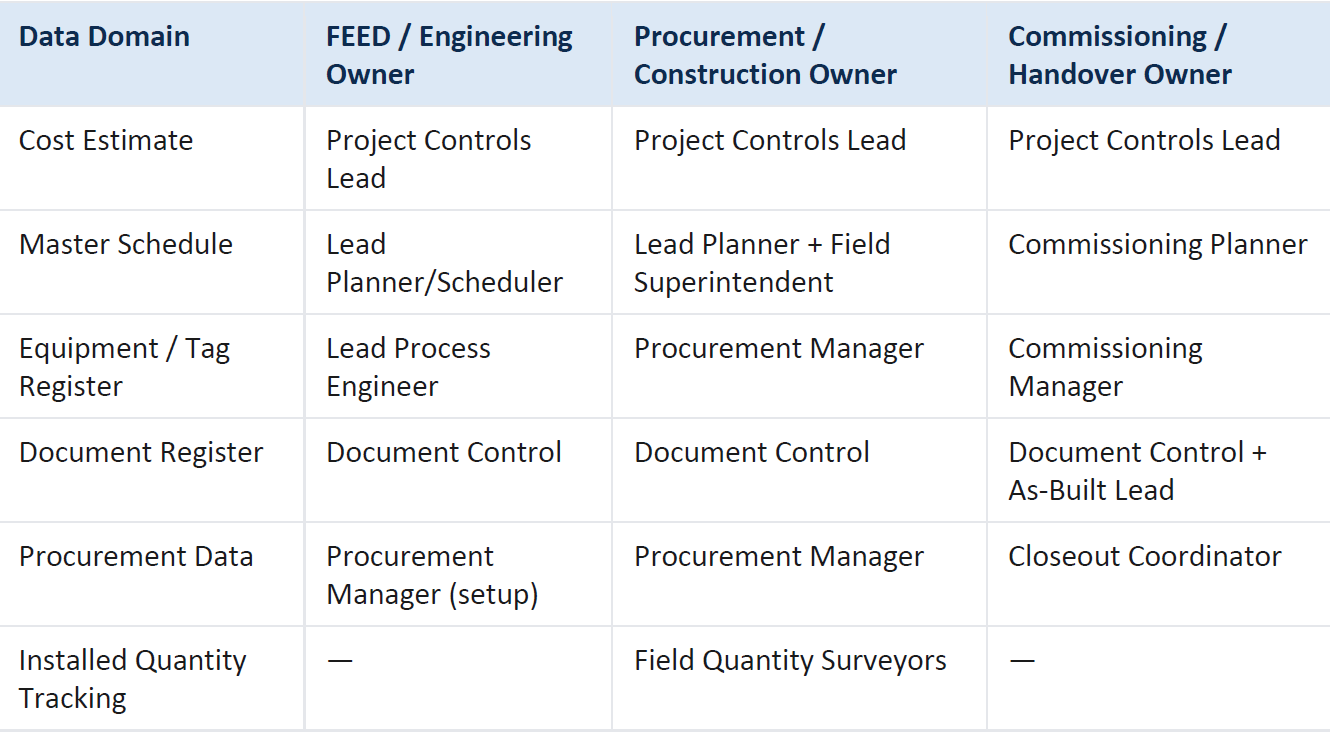

"Ownership assumed is ownership lost. Data quality on capital projects is directly proportional to the specificity of the accountability model."
Ownership transfers must occur formally at phase gates — documented in the project execution plan, acknowledged by both transferring and receiving parties, and confirmed through a structured data quality review at the gate. Organizations that rely on informal handoffs between teams invariably discover gaps at the worst possible time: during commissioning, when missing tag data or incomplete ITPs delay system turnover and push startup dates.
System Integration Architecture — The Five-System Stack
Each system in the project technology ecosystem produces data. Integration determines whether that data becomes intelligence or remains siloed information that requires manual reconciliation. The five-system integration stack below is the minimum viable architecture for a well-governed fab EPC program. Each system must be connected — not interfaced manually, but integrated with defined data flows, validation rules, and update frequencies.
BIM / 3D Model (Engineering Source): Piping, structural, and equipment models. Feeds the tag register, quantity takeoffs, clash detection outputs, and area/system definitions. Exported to schedule WBS and procurement package boundaries. The BIM model is the geometric source of truth — every downstream quantity and area definition flows from it.
Project Schedule (P6 / MS Project): WBS-linked activity list. Consumes BIM work package definitions. Produces earned value baseline, critical path analysis, and lookahead windows. When resource-loaded, the schedule links directly to cost management. Procurement need-by dates are activity-level schedule milestones, not stand-alone spreadsheet entries.
Procurement / ERP: PO commitments, invoice matching, and material tracking. Consumes BIM material lists and schedule need-by dates. Produces committed cost actuals and delivery forecasts that feed the cost management system for EAC development. The ERP is the financial source of truth for committed and incurred costs.
Fabrication Tracking: Module and skid fabrication progress reporting, ITP completion status, and factory acceptance test (FAT) records. Linked to schedule milestones and procurement delivery dates. Produces release-for-shipment date actuals that update the schedule and trigger logistics planning sequences.
Field Execution (Mobile / CMIS): Installed quantities, rework tracking, punchlist management, and manpower actuals. Consumes schedule lookahead windows and IFC drawing packages. Produces daily actuals for cost and schedule earned value — the real-time signal of field productivity performance.
"Data must flow left-to-right in near real-time. Any manual re-entry breaks data integrity and introduces reconciliation risk."
The Common Data Environment (CDE) is the connective tissue between all five systems. It is not merely a file repository — it is the governed platform through which data moves between systems with defined metadata, version control, and access permissions. A CDE without governance rules is a shared drive with a better interface. A CDE with governance rules is the operational backbone of the project data model.
Organizations that have not implemented at least three of the five systems in an integrated configuration before peak construction should expect significant manual reconciliation burden during execution — and should plan for the associated cost and schedule risk accordingly.
Actuals Reuse and Lessons Learned — Closing the Feedback Loop
The most underutilized asset in any capital projects organization is the data from the last project. Lessons learned have no value unless they change the next estimate, schedule, or process. Most organizations capture lessons at closeout and file them. They are rarely retrieved, rarely reviewed before the next estimate is issued, and rarely applied in a systematic way. This is a discipline failure, not a technology failure.
An effective actuals reuse program has four components:
1. Actuals Library: Normalize unit rates from field actuals — dollars per ton, dollars per linear foot, labor hours per installed unit. Store by system type, scope complexity, contractor performance profile, and site conditions. These normalized rates serve as estimating benchmarks for Class 4 and Class 5 estimates on future projects, replacing pure judgment with evidence-based reference data.
2. Variance Analysis Register: Document every variance exceeding 5% of cost or schedule with a structured root-cause analysis. Categorize variances: scope growth, estimate error, productivity loss, vendor delay, or site condition deviation. Feed the categorized root causes back into the risk register templates used for the next project — so that known failure modes are reflected in risk allowances before execution begins.
3. Lessons Learned Protocol: Structured capture at each phase gate — not exclusively at project closeout. By the time a project reaches closeout, the team members with the most relevant execution knowledge have often demobilized, and the organizational memory of mid-execution decisions is largely gone. Mandatory review before the next project estimate or schedule is issued. Sponsor-level sign-off required for any lessons that affect risk allowances or estimating assumptions.
4. Data Reuse in New Estimates: Actuals unit rates applied to new estimates with location, scope complexity, and market condition adjustment factors. A disciplined actuals reuse program narrows the Class 5 estimate range from the standard ±50% band toward ±30% — a meaningful improvement in capital allocation decision quality for ownership teams evaluating project sanction.
"Reuse of actuals is the single highest-ROI investment in estimating accuracy for repeat semiconductor fab programs. The data already exists — the discipline to retrieve and apply it is what is missing."
The Four-Phase Roadmap to Data Maturity
For organizations building this capability from scratch — or rebuilding after a failed implementation attempt — a phased roadmap is essential. The most common failure mode is attempting to do everything at once: implementing a new CDE, integrating five systems, launching a lessons-learned program, and retraining a project team simultaneously while execution is underway. The result is partial adoption of everything and full adoption of nothing.
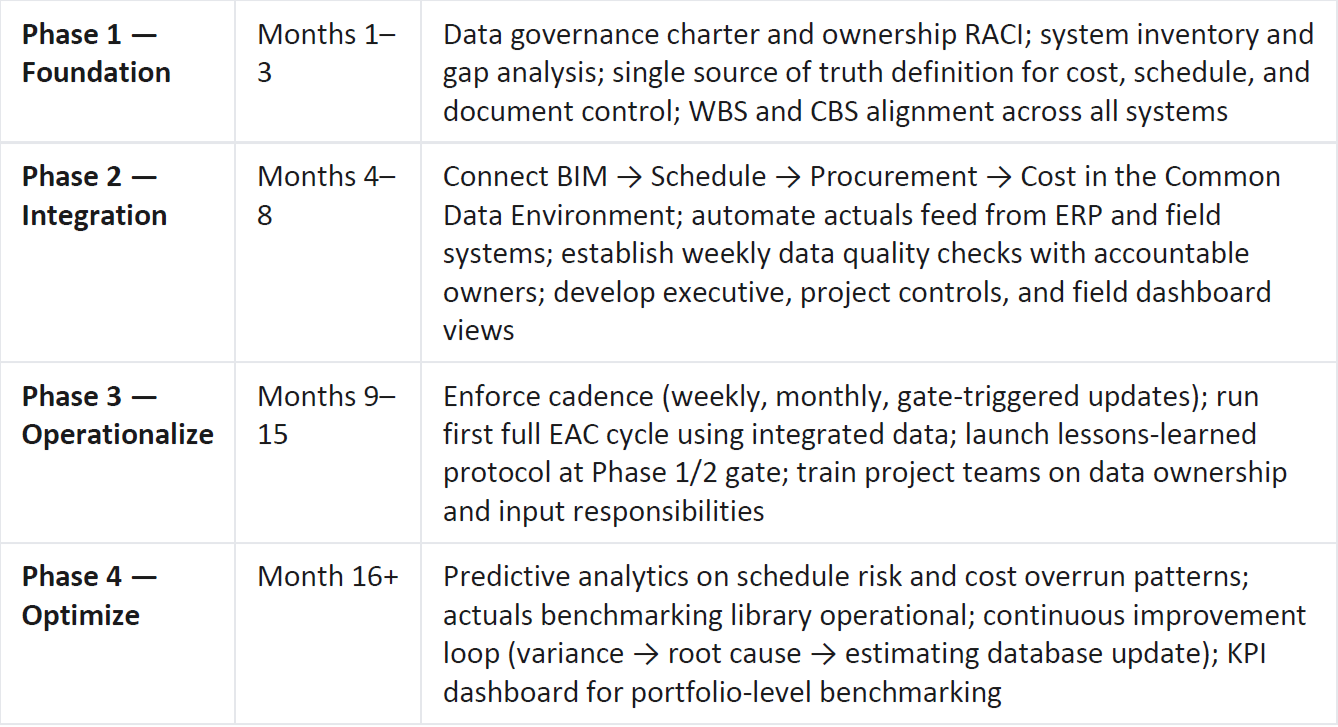
Skip Phase 1 and the entire model collapses. Governance is the foundation — technology is the accelerant, not the substitute.
Organizations that begin with Phase 2 — technology integration — without completing Phase 1 governance work consistently report the same outcome: connected systems producing inconsistent data, because the rules governing what goes into those systems were never defined. The governance charter and RACI are not administrative overhead. They are the engineering specification for the data model.
Six Decisions Leadership Must Make Now
A semiconductor fab is among the most data-intensive capital projects in the world. The operating model must match that complexity. For project directors, PMO heads, and owners reading this: these are not future-state aspirations. They are decisions that must be made — and locked — before the next major execution phase begins. Delay compounds cost.
1. LOCK the baseline. Designate a formal change control process before the next forecast cycle. No locked baseline means no variance analysis — and no accountability for cost or schedule performance.
2. ASSIGN data owners by domain and phase. Publish the RACI. Make it a contract, not a suggestion. Ownership assumed is ownership lost.
3. MANDATE the four-level WBS/CBS hierarchy across all systems. Misaligned structures make integration impossible and reconciliation permanent.
4. INVEST in system integration before peak execution. Manual data transfer at 80% construction is a fire drill, not a process. The integration window is FEED and early detailed design — not the construction phase.
5. START the lessons-learned register today. Waiting until closeout loses 90% of the actionable data. Capture at every phase gate, with named accountability for follow-through.
6. APPOINT a Data Management Lead. One person, accountable for data quality, cadence, system integrity, and governance enforcement. Without a named owner, the data model is a document — not an operating model.
Organizations that invest in data infrastructure before project sanction will outperform those that retrofit it during execution on cost, schedule, and operational readiness. For semiconductor fab programs, where complexity and consequence are both extreme, data maturity is not a nice-to-have. It is a prerequisite for delivery excellence. The organizations that understand this and act on it before the first shovel turns are the ones that will consistently deliver on the promises made at FID.
About EPC Consultants
We help industrial project owners improve project certainty through front-end planning, contract reviews, project controls, risk management, and independent project oversight.
Our team works with owners to identify potential dispute risks before they affect project cost, schedule, or performance. Your concierge advisory team is here and we welcome a conversation with you. Contact us or reach out to CEO Dana Wells directly at dwells@exceedingexcellence.com.