
Why Semiconductor, AI, and Data Center Investment Is
Outpacing Global Execution Capacity
Written by Dana Wells
Executive Summary
Capital is abundant. Execution capacity is not.
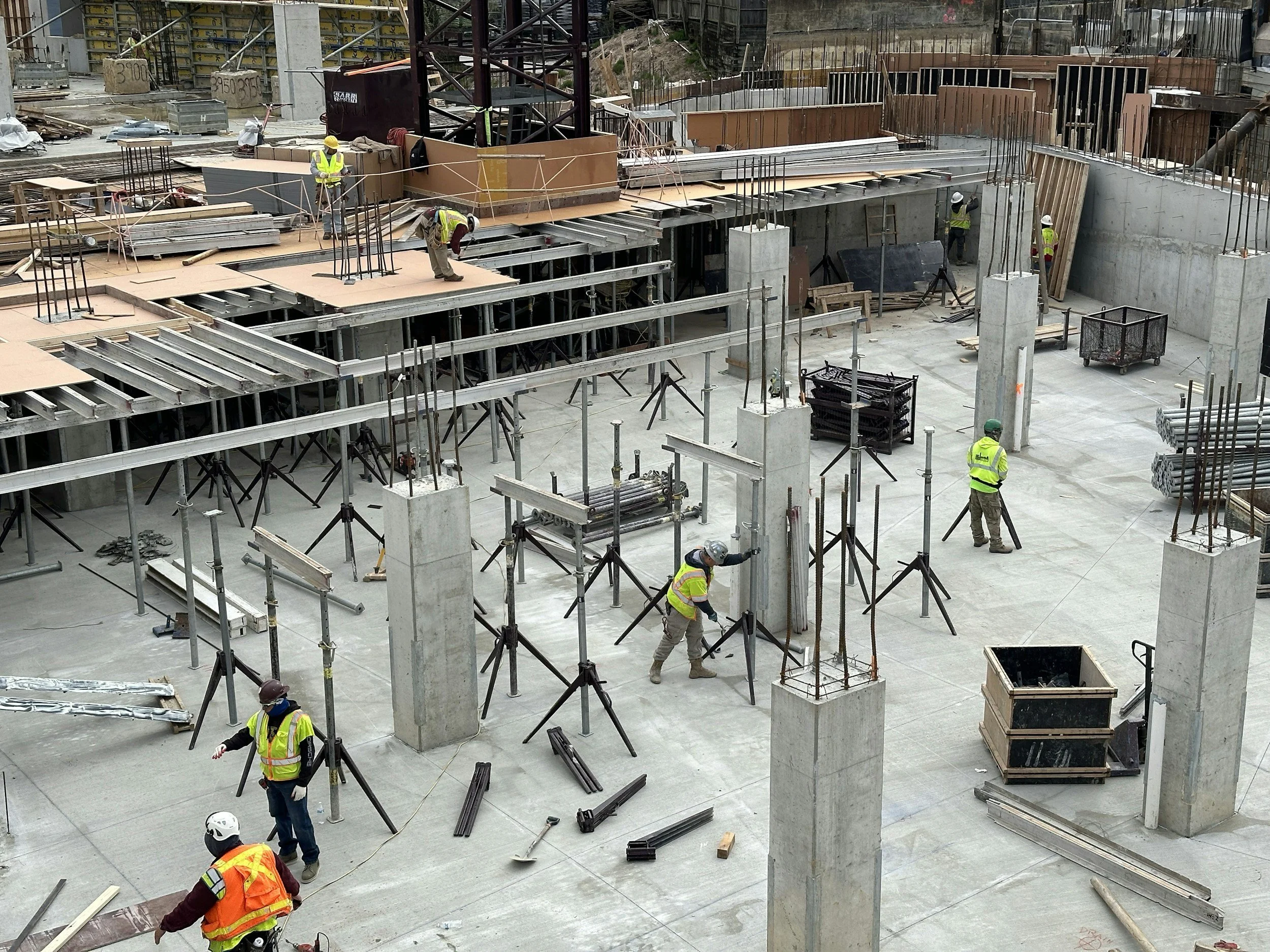
Global investment in semiconductors, artificial intelligence, hyperscale data centers, advanced manufacturing, and life sciences are accelerating at hyperscale. At the same time, the industry’s ability to convert capital into safe, reliable, operational assets is increasingly constrained.
CENTRAL THESIS
The limiting factors are shifting from access to capital toward labor, power, equipment,
commissioning, engineering capacity, and governance maturity.
Key Findings
Capital investment is growing faster than execution capacity.
Power availability is becoming a primary schedule constraint.
Specialized labor and commissioning resources remain constrained.
Long-lead procurement continues to challenge integrated schedules.
Governance and front-end planning are competitive advantages.
Owner Perspective
The defining challenge of the next decade will be converting investment into operational assets safely, predictably, and efficiently. Owners who validate execution readiness before authorization will be better positioned to protect schedule, cost, quality, and operational outcomes.
MARKET CONTEXT
The Mega-Project Expansion Era
Multiple growth sectors are drawing from the same constrained delivery ecosystem.
Between 2020 and 2026, investment accelerated at a hyper scaling rate across semiconductor manufacturing, AI infrastructure, hyperscale data centers, battery manufacturing, advanced manufacturing, life sciences, and energy infrastructure.
Shared Demands
Specialized craft and technical labor
Utility and transmission infrastructure
Engineering and construction management resources
Startup, commissioning, and qualification teams
Long-lead electrical and mechanical equipment
KEY FINDING
Capital investment is growing faster than labor availability, utility expansion, equipment manufacturing, commissioning capacity, and overall project-delivery capability.
EPC Consultants LLC’s Observation
Owners are no longer competing only for market opportunities. They are competing for execution capacity. The primary constraint is increasing execution readiness rather than project financing.
EXHIBIT 1
Global Semiconductor Growth
Demand indicators are expanding faster than specialized workforce availability.
Figure 1. Semiconductor Industry Expansion Indicators (2020-2026)

Executive Analysis
Global demand is increasing as AI, cloud computing, defense modernization, automotive electrification, and advanced manufacturing drive investment. Fabrication facilities are also becoming more technically sophisticated and more dependent upon specialized execution resources.
OWNER IMPLICATION
Manufacturing capacity is achieved only when planning, procurement, construction, commissioning, qualification, and startup are integrated effectively.
Source note: Semiconductor Industry Association; World Semiconductor Trade Statistics; U.S. CHIPS program public reporting; officially announced fabrication programs; and EPC Consultants analysis.
Methodology: Indices are normalized to a 2020 baseline of one hundred and are directional comparative indicators, not reported totals. Values should be independently validated before external reliance.
INFRASTRUCTURE SHIFT
AI and Data Centers: The New Infrastructure Race
Compute growth is changing power, site-selection, and delivery assumptions.
Large language models, AI training environments, cloud services, and high-performance computing are driving increases in facility scale, electrical density, cooling demand, and infrastructure complexity.
The resulting demand is to accelerate investment in
Hyperscale and AI data-center campuses
Transmission and distribution infrastructure
Substations and utility interconnections
High-density cooling technology
Backup generation, storage, and resiliency systems
EXECUTIVE OBSERVATION
The modern data center is among the most resource-intensive facility types being delivered, and its schedule is increasingly governed by infrastructure outside the building footprint.
Owner Perspective
Site selection and project authorization should incorporate confirmed power pathways, interconnection milestones, equipment lead times, water and cooling strategies, and commissioning capacity. A construction-ready site is not necessarily an operations-ready site.
EXHIBIT 2
Power Is Becoming the Critical Path
Utility development cycles are not aligned with the pace of digital infrastructure demand.
Figure 2. Data Center Power Demand Outlook

Executive Analysis
Power demand associated with AI and hyperscale infrastructure is increasing faster than utility expansion capacity. Transmission systems, substations, interconnections, and energization activities are emerging as major schedule drivers.
OWNER IMPLICATION
Utility readiness must be treated as a front-end planning and governance workstream, not a late construction activity.
Source note: U.S. Department of Energy; Electric Power Research Institute; International Energy Agency; publicly available utility planning forecasts; and EPC Consultants analysis.
Methodology: Indices are normalized to a 2020 baseline of one hundred and illustrate directional comparisons. They are synthesized planning indicators rather than a single published dataset.
EXHIBIT 3
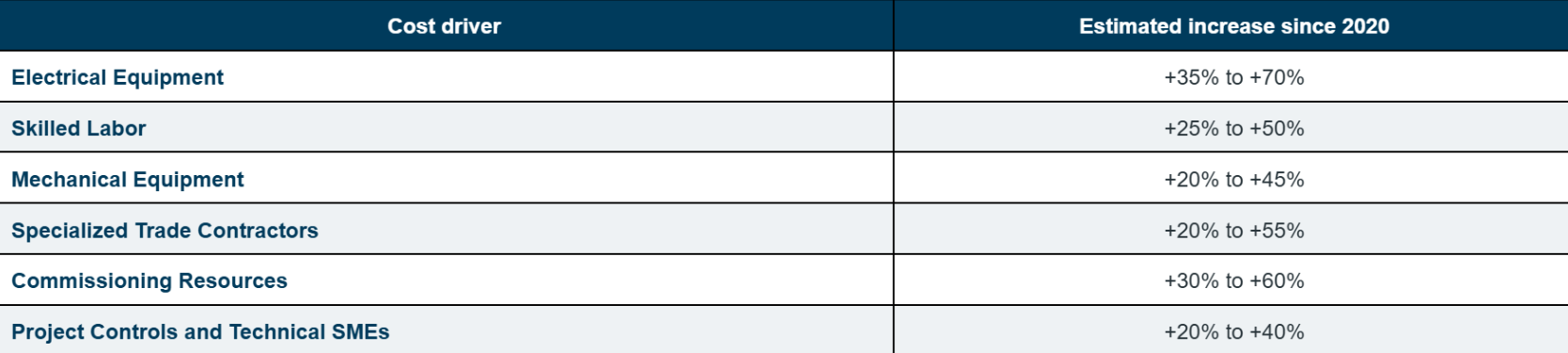
Rising Construction Costs and Commercial Pressures
Specialized systems and technical resources are experiencing disproportionate escalation.
Figure 3. Construction Cost Escalation Drivers
Executive Analysis
Project costs are being affected by labor constraints, procurement challenges, equipment shortages, schedule acceleration, and limited availability of specialized technical resources.
OWNER IMPLICATION
Poor planning, governance deficiencies, and schedule compression can create greater cost impacts than inflation alone.
Source note: Engineering News-Record cost indices; U.S. Bureau of Labor Statistics; publicly available contractor and supplier reporting; and EPC Consultants market observations.
Methodology: Ranges are synthesized directional estimates and are not a substitute for a location-specific estimate, bid, or market escalation study.
EXHIBIT 4
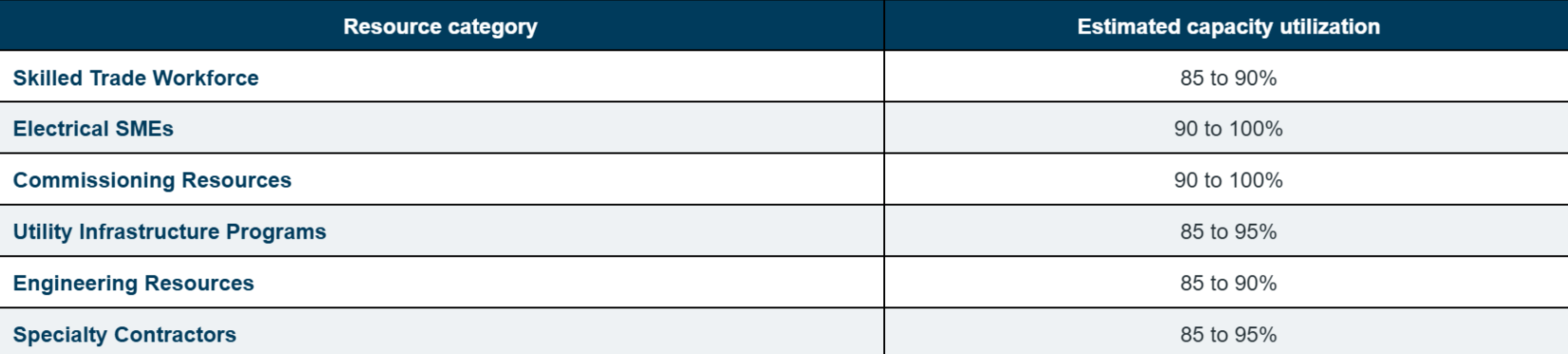
Execution Capacity Warning Indicators
Far too many critical resources are operating near practical limits.
Figure 4. Execution Capacity Stress Indicators
Executive Analysis
Constraints are emerging simultaneously across labor, engineering, procurement, utilities, commissioning, and construction management. Higher utilization reduces flexibility and magnifies the effect of disruption.
OWNER IMPLICATION
The cumulative effect of constrained resources creates materially greater risk than any individual shortage considered in isolation.
Source note: Publicly available workforce studies, utility infrastructure reports, engineering staffing analyses, commissioning market reporting, and EPC Consultants market assessments.
Methodology: Utilization values are directional estimates synthesized from multiple observations. No single cited source publishes the complete dataset shown.
LIFECYCLE INTEGRATION
Commissioning and Operational Readiness
Commissioning is a project-delivery function, not a closeout event.
Mission-critical facilities require commissioning involvement from planning through turnover. Early engagement improves design review, testing strategy, system boundaries, procurement requirements, turnover sequencing, and operational readiness.
Leading Integration Points
Basis-of-design and design reviews
Procurement specifications and factory acceptance testing
Systemization and turnover planning
Energization and startup sequencing
Integrated systems testing
Training, documentation, and operational acceptance
OWNER IMPLICATION
Commissioning should be governed as a lifecycle workstream with defined authority, deliverables, resources, and schedule logic.
EPC Consultants LLC’s Observation
Projects that engage commissioning teams earlier are better positioned to identify incomplete scope, coordinate interfaces, manage turnover, and achieve more predictable startup outcomes.
OPERATING MODEL
Governance as a Competitive Advantage
Complexity becomes manageable when authority, data, and decisions are integrated.
Organizations that consistently outperform peers establish governance frameworks before execution begins, not after performance issues emerge.
Effective Governance Includes
Clear decision authority and escalation pathways
Integrated cost, schedule, risk, and change controls
Reliable data definitions and reporting cadence
Formal interface and dependency management
Executive accountability for unresolved constraints
Independent readiness and assurance reviews
EXECUTIVE OBSERVATION
Governance quality increasingly differentiates successful projects from underperforming projects.
EPC Consultants LLC’s Observation
Governance converts complexity into predictability by helping owners see risk early, make timely decisions, and maintain alignment across designers, builders, suppliers, utilities, commissioning teams, and operators.
EXHIBIT 5
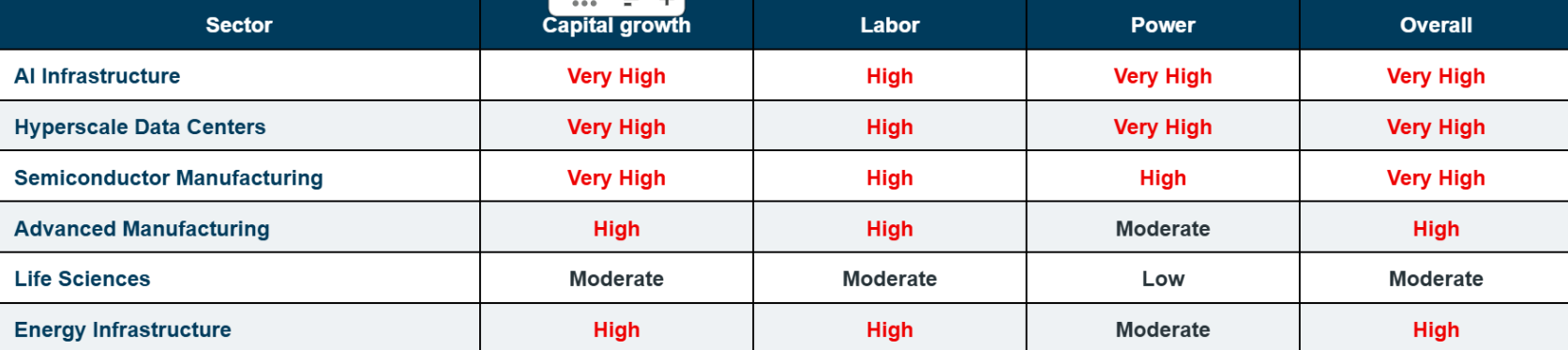
Sector Risk Dashboard and Owner Actions
The highest exposure occurs where rapid capital growth intersects power and labor constraints.
Figure 5. Sector Risk and Capacity Assessment
What should owners do now?
Validate power and utility pathways before major authorization.
Assess regional labor and SME capacities.
Align long-lead procurement with the integrated schedule.
Engage commissioning and operations during design.
Conduct independent execution-readiness reviews.
Source note: Officially announced capital projects, industry investment reporting, utility planning studies, workforce reports, and EPC Consultants LLC analysis.
Methodology: Ratings are qualitative strategic assessments, not probability forecasts or investment ratings.
CONCLUSION
The Great Capacity Gap
Disciplined execution will define the organizations that successfully convert investment into operations.
The global economy is entering one of the largest industrial expansion cycles in modern history. The greatest challenge facing owners is not identifying opportunities or securing capital. It is converting investment into operational assets while navigating constrained labor, utility, procurement, commissioning, and engineering markets.
CLOSING PERSPECTIVE
Organizations that establish disciplined governance, realistic execution strategies, integrated commissioning programs, utility readiness plans, procurement discipline, and initiative-taking risk management before construction will be best positioned to succeed.
Data and Analysis Disclaimer
This white paper combines publicly available industry information, market reports, government publications, infrastructure studies, and EPC Consultants LLC professional analysis. Certain exhibits use indexed values, directional indicators, comparative baselines, and forecast ranges for strategic discussion. These exhibits are not forecasts, guarantees, investment advice, or representations of future project performance. Users should independently validate quantitative assumptions before relying upon them.
About EPC Consultants LLC
We help industrial project owners improve project certainty through front-end planning, contract reviews, project controls, risk management, and independent project oversight.
Our team works with owners to identify potential dispute risks before they affect project cost, schedule, or performance. Your concierge advisory team is here and we welcome a conversation with you. Contact us or reach out to CEO Dana Wells directly at dwells@exceedingexcellence.com.